
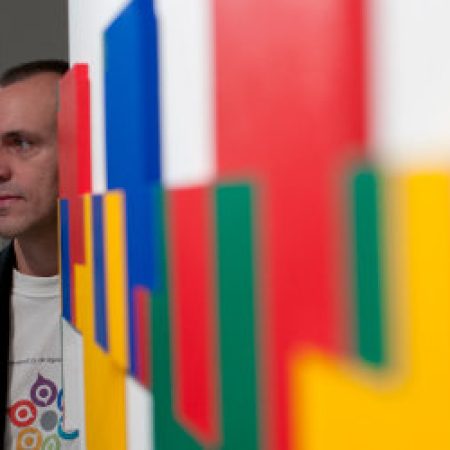
Janos Szasz Saxon
Born in 1964 in Tarpa, Hungary
1978–1982 — Studies at Zrínyi Ilona High School in Nyíregyháza
1982–1990 — Works at Pesti Műhely; student of constructivist artists Tibor Csiky and János Fajó
1984–1988 — Studies at Bánki Donát Technical College (University of Óbuda), Budapest
1990s — Development of his poly-dimensional flat painting; beginning of his MADI works under the influence of Carmelo Arden Quin
Early 1990s — Co-founding of several artistic movements; editing of international journals
2000 — Publication of Saxon’s Dimensional Pencil
2002 — Publication of Saxon’s Poly-Dimensional Fields by Géza Perneczky
2010 — Publication of Saxon’s Poly-Universe; settlement in Szokolya and construction of a studio; launch of the 50 Years 50 Sculptures project
2016 — Full member of the Széchenyi Academy of Literature and Arts (Academy of Sciences)
2019 — Publication of PUSE Methodology (Poly-Universe in School Education)
Born in 1964 in Tarpa, Hungary, Saxon Szász János is an artist who defies easy classification, working at the intersection of art, mathematics, and philosophy. Trained from secondary school under constructivists Tibor Csiky and János Fajó, and later shaped by the influence of Carmelo Arden Quin — founder of the international MADI movement — and Kazimir Malevich, he has spent over fifty years developing an abstract and geometric body of work of rare coherence.
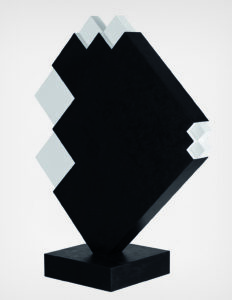
At the heart of his practice lies the concept of the Poly-Universe: a visual system based on flat structures at variable scales, which art historian Géza Perneczky has likened to fractal geometry — though Saxon developed it entirely independently, through the observation of nature. His densified wood sculptures — oil-painted in a palette dominated by yellow, white, and black — explore the passage from painting to object, from plane to space, from the visible to the invisible. Yellow embodies the vitality of the physical world, white transcendence, and void the reality beyond matter.
A member of the Széchenyi Academy of Sciences since 2016 and a multiple recipient of the Pollock-Krasner Award, Saxon is also a tireless cultural connector: co-founder of artistic movements, editor of international journals, organiser of hundreds of exhibitions worldwide, and founder of the Mobile MADI Museum in Vác, which brings together five hundred works by artists from sixteen countries.
1978–1982 : Élève au lycée Zrínyi Ilona, Nyíregyháza.
1982–1990 : Travaille au Pesti Műhely, Budapest.
1984–1988 : Études au Bánki Donát Technical College (Óbuda University), Budapest.
1989 : Diplôme en collaboration avec le Collège des Arts Appliqués — sculpture plastique soudée dans l’espace public.
Années 1990 : Développement de la peinture poly-dimensionnelle sur plan, puis du système Poly-Universe.
Années 1990 : Création de mouvements artistiques avec Zsuzsa Dárdai ; édition de revues internationales (MADI, Árnyékkötők / Shadow Binders) ; organisation d’expositions et de festivals en Europe, Amérique du Nord et du Sud.
Années 1990 : Création du Mobile MADI Museum à Vác — environ 500 œuvres de 150 artistes contemporains issus de 16 pays.
2000 : Publication de Saxon’s Dimensional Pencil.
2002 : Publication de Géza Perneczky : Saxon’s Poly-Dimensional Fields.
2010 : S’installe à Szokolya ; construction d’un atelier ; lancement du projet 50 Years 50 Sculptures. Publication de Saxon’s Poly-Universe.
2016 : Membre titulaire de l’Académie Széchenyi des Lettres et des Arts, Académie des Sciences de Hongrie. Ouverture de la SAXON Art Gallery, Budapest. Citoyen d’honneur de Szokolya.
2019 : Publication de PUSE Methodology (Poly-Universe in School Education).